Showing posts with label wholeness and unity. Show all posts

Wednesday, September 15, 2010

I Bow to the Power of Folk Music

Last night, a Butler friend of mine, Emily, and I met up to go to FreshFest, which was supposed to be a huge array of performers and musicians showcasing their stuff, trying to get people excited to join their club at the club fair tomorrow. It worked well for about an hour, and it actually ended with the improve group I had wanted to see last night, but the tickets had been sold out – but it ended a t 9 p.m. when it was supposed to end at around midnight. Emily and I left and stood outside Pleasance, trying to decide what to do next. We consulted her handy Fresher’s Week orientation schedule, and there was folk music starting at 9 p.m. on 48a Pleasance. We found the correct door, marked “48a” in chalk on the side of the door. It was essentially what you would expect a university music festival to be: located somewhere really hard to find, but very amusing in its hard-to-findness.

For two hours, I sat on a wooden floor and listened as fiddlers, flutists, and guitarists strummed and made music. A lot of us were cramped together in a warm room with yellow-gold light. People struck up tunes, and other players would join in and try and follow along. If they didn’t know the tune, they would play notes to complement and harmonize.

There was something in that music. Any music, live, that you hear, you can feel pulsing within you. The beat seems to match the rhythm of your heart, and so something greater has come into being. There is a saying that when words fail, music speaks, and to me, last night, it spoke to something deeper and more ancient and more sophisticated than words. It invoked ancestral memories which I didn’t even know I had. I have only a few threads of ancestry coming from Scotland, but I was like I was remembering something, like the very blood in my veins was remembering what it was like to listen to this music, to be part of a folk music tradition that was enriched by people adding to songs and changing them and making them their own. To think of people sitting around a fire in their pittance-poor homes but clinging to and loving their traditions. It was like a glimpse into my own history, my past, my forebears.

I am now and forever will be a fan of folk music.

Monday, August 2, 2010

How to Make an Interesting Photograph (Or: How to Make Photographs at Which You Don’t Cringe Every Time you See Them)

This may be a part in a longer series. My rage at poorly-taken pictures has abated, but that's not to say it won't flare up at a later date.


Whenever my family goes on trips and we only have one camera, I automatically make myself in charge of the camera (unless J-Chan is with me – then we can switch if we don’t have two cameras. Come to think of it, not having two cameras is a situation we will rarely encounter because it’s so important for all of us kiddio-sies to have them. Katie-Po might also be an exception). I have a compulsive need to be in control and take good pictures. If anyone else takes the photographs, I get annoyed and frustrated because they are done in a curmudgeonly fashion. No one has enough sensitivity to frame and composition.

To take a picture, it first helps to have something to take a picture of. I’m feeling lazy, so these pictures will be old ones from my albums.

Pictures with people and famous things - Pictures of a person standing in front of a famous thing are a great way to personalize your pictures and make your trip more memorable, and to all those non-believers back home you can point to the picture and say “Proof!” until they refute you with “Photoshop!” Once that accusation has been made, you can't really refute it, though. However, you know you were there, and that’s what matters. 

And I am here so you can take better pictures of that person standing next to that famous thing.

First thing you should know: take as few pictures of the person in the dead center of the picture as you can. In an interesting picture, your eye will move around (namely, from that person to famous thing and back). You need a really good reason to take a picture of the person in the middle – for example, imagine someone sitting along a wall with their feet up. If you’re near their feet, take a picture of them. This will mean that your camera will catch the depth as your friend’s feet go away from you, and their feet become their body, and their body becomes their face.


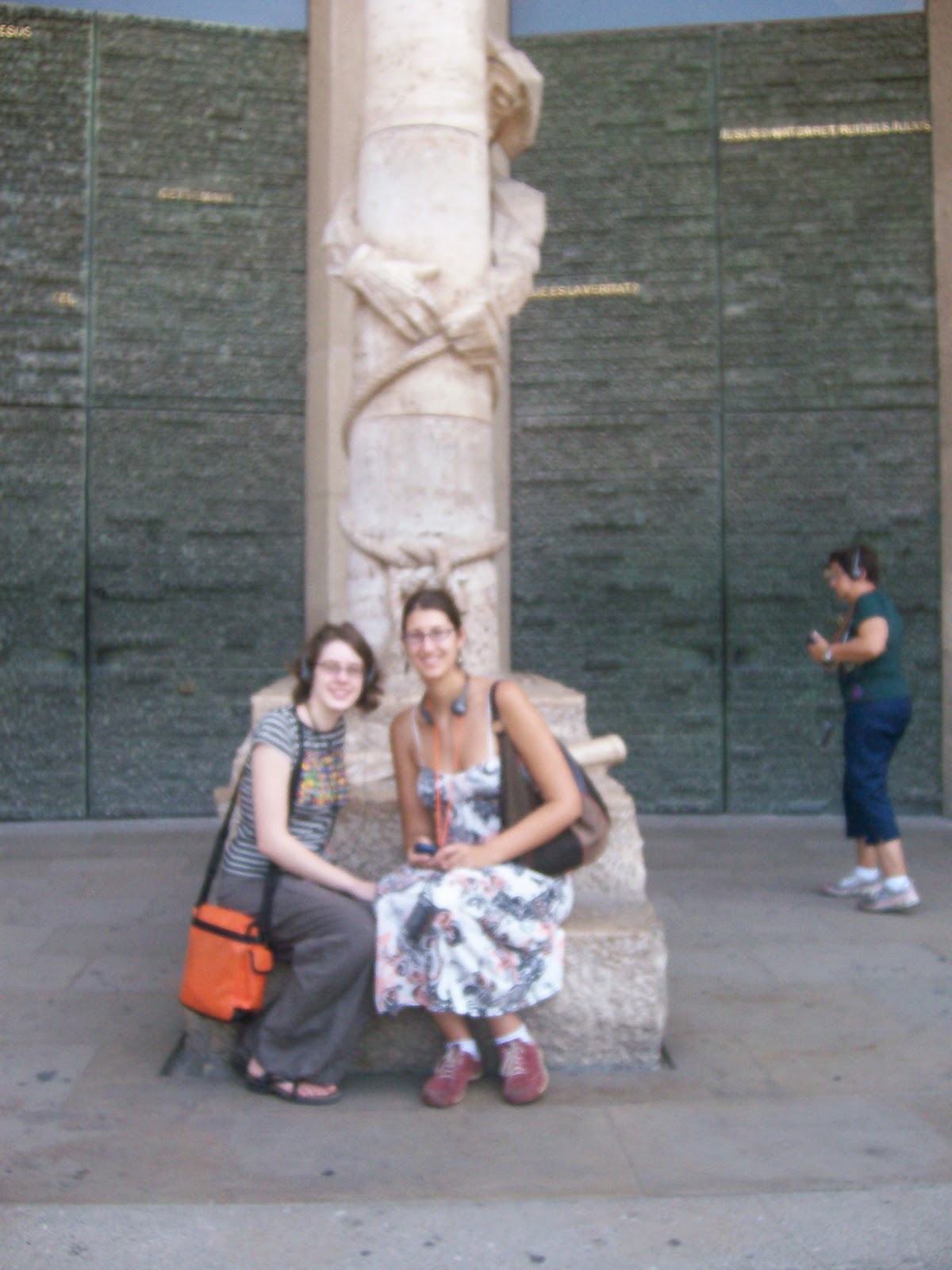
In the picture above are Teddy and me. Yes, we are important, but what we’re sitting behind is also important – a Cubist statue of Christ being scourged. Note that the angle of the picture has cropped out most all of Christ's body and that there is a lot of empty space at the bottom of our feet. Due to the vertical nature of the statue, I am okay with having Teddy and me be in the center of the picture, and even though I don't want a picture of a tourist in front of the Sagrada Familia (such as is there on the right), it actually balances out the picture. Also, this is not a good picture because it is blurry.

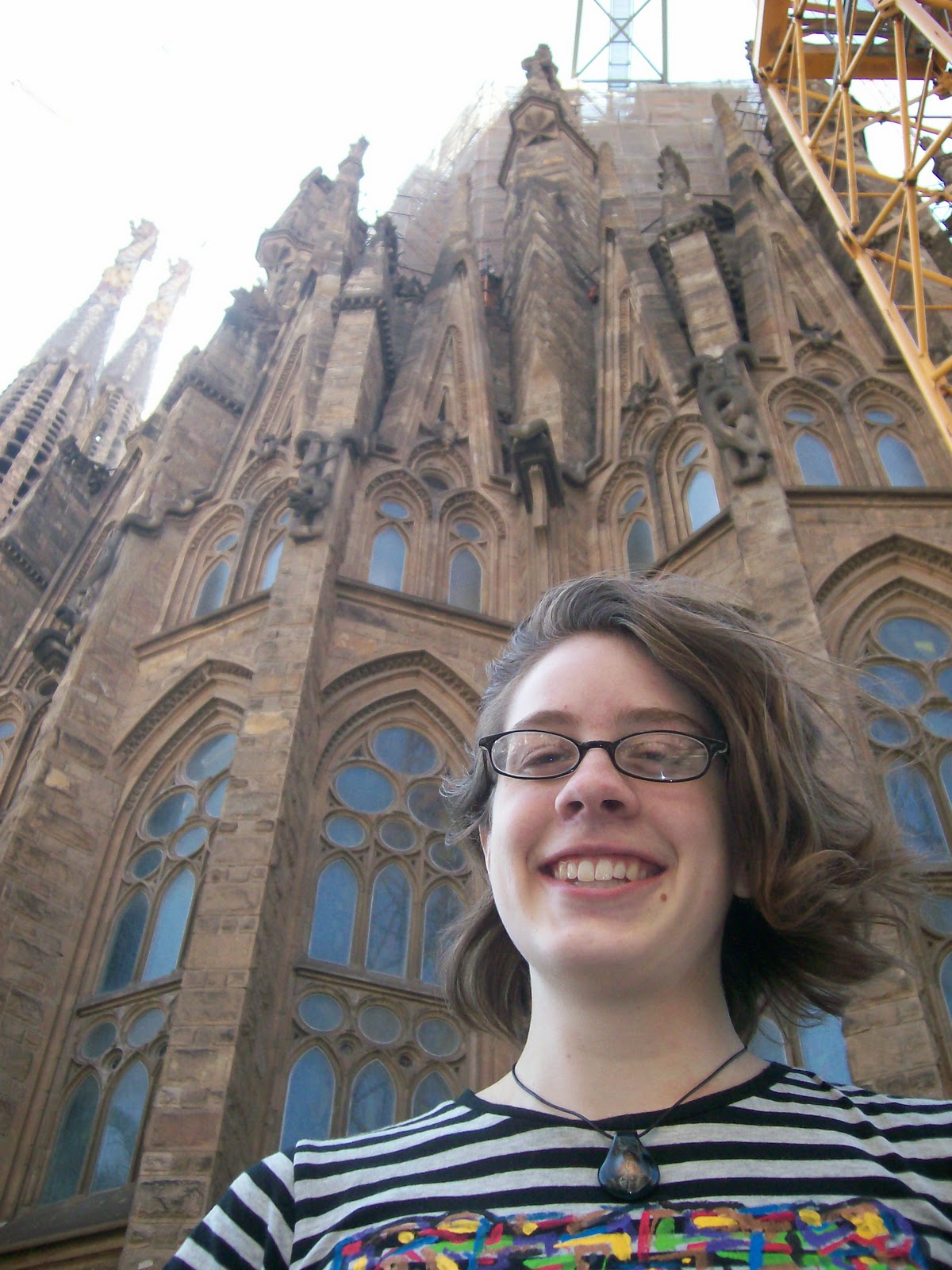
It is not necessary to take a full-body picture unless you want to expressly include that person’s clothes or to show how big/small the famous thing is. Besides, your head is smaller than your body. (Unless you are a baby, in which case your parent should have taken loads of pictures of you, some of them are bound to be good, and hey, most of these rules don’t apply to you anyway because you’re a baby.) Any picture taken of that person from the bust up is acceptable, because it means you as the photographer are close enough to get the details of his/her beautiful, radiant face, while still getting that famous thing in the background. Like so:

Depth! Bust! I wish there weren't a crane in this photo!

Okay, I somewhat liked the sultry look of the full-body shot. But note: I am not in the center, and my body is balanced by the Holy Family on the left and the strong diagonal of the column.

Friday, March 5, 2010

The Mirror Experiment

On Sunday, I decided to cover up the mirror over my sink and the mirror in my closet. Ideas had been bouncing around in my head, ideas about Lacanian’s theories of the self. I do not profess to have any great knowledge of what Lacan was trying to say in “The Mirror Stage,” but a thread of his theory has stayed with me: by looking in the mirror, I alienate myself from myself. By looking at myself in the mirror, I do not see me but rather how other people see me. Antoine de Saint-Exupery’s novel says that the essential is invisible. An essential part of me is invisible, as well – but here I start treading on thin ice. By veering into the territory of the “invisible,” I inevitably think of abstract, disembodied concepts. The mind is invisible, and if we think of the mind, then diametric opposite which follows naturally is the body. Thank goodness that in everyday jargon we don’t readily think of the mind/body dichotomy. I might say that we allow a trichotomy of mind/body/soul. However, we can lump mind/soul together, leaving us still to contend with the dichotomy of internal/external. May I have a third option? The essence of who I am does not lie more in the mind than the body, or the body more than mind. I am both. My body and how I think – not to mention how I feel – are me.

I covered up my mirrors because I did not want to alienate my perception of myself from who I actually am any longer. I grabbed a scarf and darkened the mirror, and doing so felt like cutting a string that tied me, wrist-to-wrist, to a vague presence. I didn't even know that presence existed until it was gone. The scarf covering the mirror is crocheted in an elaborate pattern, and though I can still see the mirror through the holes, it is like I have control over the portal to a mystical land. I know most poignantly that the mirror is still there, as did my roommate and probably most of my friends who have come to our room since I covered them. I do not have to look at myself when I brush my teeth, brush my hair, put in my contacts, get dressed.

My roommate’s mirror remains uncovered, however. When I am in a rush or can’t help myself, I take a peek in the mirror to make sure my hair parts the way it usually does, to make sure I don’t have that fabled bit of broccoli stuck in my teeth. I cannot escape the fact I see my face when I use a public restroom, or that I catch my reflection in a window or in my computer screen. I check to make sure that my hair is still parted neatly, or if I’m wearing my glasses, that they aren’t askance – it’s almost impossible not to. But the place I see my face most is in my room, and I have dealt with that.

I usually wear what clothes I please, and comfortable clothes, at that. But over the past few days, I have felt even more comfortable because I was not seeing what I would look like and how other people would see me. It’s a strange feeling to try to convey. I felt at peace with myself, like there was harmony between my inner mind and my outer body. I wish I could say that there was no difference between my mind and body, that I could not distinguish one from the other. The barrier still stands, but the lines have been blurred a little. I like not looking at myself but rather being myself.